Social Skills &
Communication Support
- Home
- What we help with
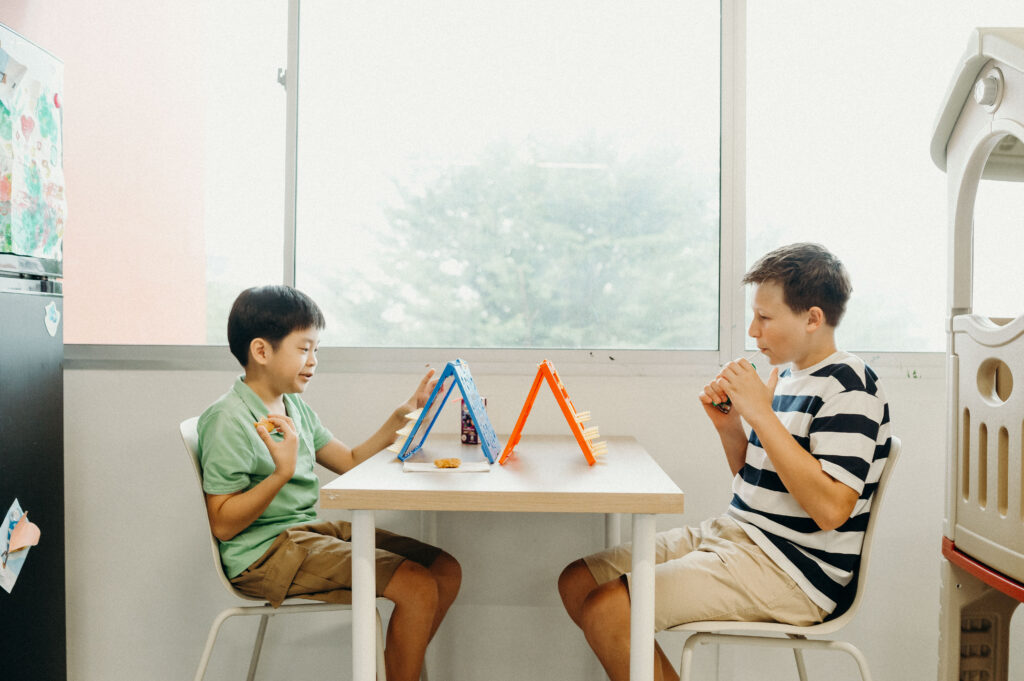
For children who want or need to connect, communicate and take part with other people, but find the social side of everyday life difficult.
Social skills are not just about being talkative, making eye contact or having lots of friends. They include noticing another person, responding, joining in, expressing needs and boundaries, working through misunderstandings and knowing what to do when an interaction does not go as expected.
At Tesserae, our social skills training focuses on practical skills children can use with peers, family members, teachers and other people in their everyday lives.
What do social skills and communication actually mean?
Communication is more than how clearly a child can speak. Social interaction also asks children to use communication with another person, in the moment.
A child may need to work out when to join, how to respond, how much information to give, what another person may be trying to communicate, and how to repair the interaction if something goes wrong.
What can social difficulties look like day to day?
Social difficulties do not always look like a child who avoids other people. Sometimes the child is very social, but interactions are still hard to manage.
For some children, these differences are noticeable from a young age. For others, they become more obvious as friendships, group work and playground interactions become less structured and more socially demanding.
Why can a child talk well but still struggle socially?
Knowing language and using it successfully in a social interaction are related, but they are not the same skill.
This is why a child can have a strong vocabulary and still find peer interactions difficult. The challenge may be using their skills flexibly and independently when another person is involved.
What skills do we work on?
There is no checklist of social behaviours that every child needs to perform. We look at where your child is getting stuck and what would help them participate, communicate or advocate for themselves more independently.
Does my child need to be more social?
Not necessarily.
Some children prefer one or two close friends, quieter environments or more time on their own. That preference alone is not something we need to change.
Support becomes more useful when there is a gap between what the child wants or needs to do socially and what they are currently able to manage. For example, they may want to join other children but not know how, repeatedly lose friendships they value, or depend heavily on adults to manage interactions for them.
How can Behaviour Support help?
At Tesserae, we describe what we do as Behaviour Support. Our work is grounded in behavioural science and Applied Behaviour Analysis (ABA).
For social skills and communication, that means looking at the situations where interactions become difficult, identifying the skills involved, teaching those skills in manageable steps, and creating opportunities to use them with other people.
How do skills move into real interactions?
Social skills need other people. A child may be able to answer a question correctly in a quiet 1:1 session and still find the same skill much harder with a peer who responds unpredictably.
That is why the setting should change as the child becomes ready.
Questions parents usually ask us
My child is very talkative. Can they still struggle socially?
Yes. A child may have a strong vocabulary and still find peer conversations, joining, negotiation or repairing misunderstandings difficult. The question is not how much they can talk, but how independently they can use communication in an interaction with another person.
Does my child need an autism diagnosis?
No. Social and communication difficulties can occur with or without a diagnosis. We work from the child’s functional needs rather than requiring a diagnostic label before support can begin.
Is 1:1 Behaviour Support or a Social Skills Group better?
It depends on the child’s starting point and the skill being targeted. Some children benefit from learning a skill more explicitly in 1:1 sessions first. Others already know what to do in theory and need more practice with peers, where interactions are naturally less predictable.
My child likes playing alone. Should I be worried?
Not simply because they prefer being alone. We are more concerned when a child wants or needs to participate but repeatedly cannot, is distressed by social difficulties, or depends on adults to manage interactions that matter to them.
Can Behaviour Support help with communication?
Yes, when the goal is functional communication, such as asking for help, expressing needs or boundaries, responding to others, or using communication more effectively in everyday situations. Where the primary concern is speech or language development, we would recommend Speech and Language Therapy.
Will you work with my child's school?
Where useful, yes. Social difficulties can look very different in a classroom or playground than in a therapy setting. With parental consent and the school’s agreement, we can observe, collaborate with teachers or provide support within school.
This page provides general information and does not provide a diagnosis. Where a speech-language, psychological, medical or other specialist assessment is appropriate, we will recommend that families speak with the relevant professional.
On this page
Not sure what your child needs?