Global Developmental Delay (GDD) describes a developmental profile where a young child is progressing more slowly across several areas of development. For children with GDD, the pattern and degree of delay can look very different from one child to another. This may include communication, learning, movement, social participation or everyday independence.
At Tesserae, the diagnosis is not the programme. We look at what your child can already do, what is currently getting in the way, and which next skills are likely to make the biggest practical difference.

GDD is a broad developmental description. It tells us that development is delayed across more than one area, but it does not tell us exactly why, what your child’s longer-term developmental profile will look like, or which intervention should come first.
That is why support should be based on the child’s current strengths and needs rather than on the label alone.
Families often notice that progress is happening, but at a different pace across several areas. The difficulty is not always obvious from a milestone checklist alone.
For children with GDD, a long list of delayed milestones can make intervention feel overwhelming. Trying to work on everything at once can spread support too thinly.
Instead, we look for skills that open up more opportunities to learn, communicate and participate.
The areas we prioritise depend on the individual child. GDD support may involve several developmental areas, but not every goal belongs within Behaviour Support. Some needs are better addressed by another professional.
Because GDD can affect multiple areas of development, no single discipline should be expected to address every need. A child’s developmental delay support team may look different depending on their profile and priorities.
With parental consent, we can collaborate with other professionals involved in your child’s care. If another discipline is better suited to a particular need, we will say so.

Tesserae’s Behaviour Support is grounded in behavioural science and Applied Behaviour Analysis (ABA). ABA provides a systematic way to understand what is helping or getting in the way of learning, teach skills in manageable steps and measure whether those skills are becoming more independent.
For families looking for ABA therapy for GDD or GDD therapy, goals might include communication, learning readiness, following routines, participating in activities or completing everyday tasks with less help.
For children with GDD, development is not simply a checklist of isolated milestones. Some foundational skills can make it easier to learn many other things and participate more independently.
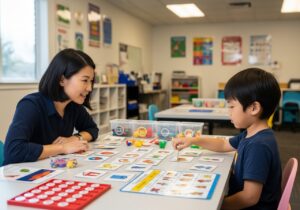
Some children initially need highly structured 1:1 teaching. But skills should not stay dependent on the therapy room or on one therapist.
As learning becomes more stable, we want the child to use those skills with parents, teachers and peers, during everyday routines and in the settings where they are actually needed.
We begin by understanding your child’s current development, the areas that are most difficult day to day and what would be most useful to work on first.
Tell us what you are seeing and what you are most concerned about. We will help you decide whether an Initial Screening & Consultation is likely to be a useful next step.
We spend direct time with your child and speak with parents to understand strengths, current difficulties and developmental priorities. Afterwards, we discuss our observations and recommended next steps.
If ongoing support is appropriate, we begin with a small number of meaningful goals and choose the setting and level of support that best fit your child’s needs. The plan develops as we learn more through early sessions and ongoing review.
We review progress, help skills generalise across people and environments, and change the level or setting of support as your child becomes more independent.
No. We can support a child based on the difficulties they are experiencing and the skills they need to build. If your main question is whether your child has GDD or another developmental condition, a formal developmental assessment should be completed by an appropriately qualified professional.
Not necessarily. GDD describes a child’s current developmental profile and does not by itself determine their longer-term outcome. Development continues over time, and the picture may become clearer as a child grows, learns and receives further assessment.
We look for the skills that are most likely to affect what your child can learn and do next. That often means prioritising access to learning, functional communication, participation or independence rather than trying to address every delayed milestone at once.
Yes. ABA principles can be used as part of GDD support to teach practical skills in smaller, achievable steps and measure whether learning is occurring. For a child with GDD, this might include communication, following instructions, participating in routines, learning through imitation or completing everyday tasks more independently.
No. These disciplines address different areas of need. A child with GDD may benefit from more than one. We work within our scope and, with parental consent, can coordinate with the other professionals involved.
Yes. We can work on learning-to-learn skills such as engaging with activities, following instructions, participating in routines, communicating needs and becoming more independent. Where useful and the school agrees, support can also extend into the classroom.
It can. GDD is often used when a child’s broader developmental picture is still emerging. As a child grows and receives further assessment, clinicians may gain a clearer understanding of their developmental profile or identify a more specific diagnosis. Formal diagnostic decisions should be made by the relevant healthcare or developmental professional.
Looking for more information about Global Developmental Delay? Visit our resources for more information on developmental support and the special needs landscape in Singapore.
Disclaimer: This page provides general information and does not provide a diagnosis or replace medical or developmental advice. If you are seeking a diagnosis or medical assessment for developmental delay, please consult an appropriately qualified healthcare professional.
Not sure what support your child needs?