Have you observed that your child may be developing certain skills such as communication, movement, play, or daily routines at a different pace from their peers? Perhaps they are taking a little longer to walk, express their needs, or complete tasks independently.
If these observations feel familiar, you may have come across the term Global Developmental Delay (GDD) and be wondering what it could mean for your child’s growth and learning journey.
In Singapore, GDD is a term used to describe young children who require additional support across several areas of development. While the term may initially sound concerning, it primarily serves as a framework to help families access early support rather than a prediction of long-term outcomes. With timely and individualised intervention, many children make meaningful progress in communication, learning, confidence, and independence.
What is Global Developmental Delay (GDD) in Singapore?
Global Developmental Delay is a term used when a child under the age of 5 shows significant delay in at least two areas of development, such as:
- Gross motor skills (e.g. sitting, crawling, walking)
- Fine motor skills (e.g. grasping, drawing, using utensils)
- Speech and language (understanding and using words)
- Cognitive skills (problem-solving, learning, imitation)
- Social and emotional skills (playing with others, sharing, turn-taking)
- Daily living skills (feeding, dressing, toileting)
Global Developmental Delay (GDD) does not mean that a child cannot learn. It means that, at this stage, development is progressing more slowly than expected for their age, and that more structured support may be needed to build essential skills.
For many children, GDD is a working diagnosis in the early years. As children grow older (often around ages 5–6), clinicians may refine the diagnosis to something more specific, such as Autism Spectrum Disorder (ASD), Specific Learning Disorder, or ADHD, or, in some cases, remove the diagnosis altogether if development has caught up sufficiently.
What matters most is early recognition and appropriate support. With the right approach, children with developmental delays can learn new skills, gain greater independence, and participate meaningfully at home, in school, and in the community.
Understanding what causes GDD
In many cases, there is no single clear cause. Possible contributing factors include:
- Genetic conditions or chromosomal differences
- Complications during pregnancy or birth
- Prematurity or low birth weight
- Brain injuries or infections in early life
- Environmental factors (e.g. limited stimulation, prolonged illness)
Most importantly, GDD is not caused by “bad parenting”. It is a difference in development, not a reflection of your love, effort, or care as a parent. Knowing this allows you to shift your energy towards what matters most: getting the right support in place early.
Early signs of GDD
GDD can look different in each child, but common early signs include:
Motor Skills
- Not sitting, crawling, or walking around the expected age
- Poor balance or coordination, frequently tripping or bumping into things
- Difficulty using hands for simple tasks (e.g. holding a spoon, stacking blocks)
Speech and Language
- Limited babbling or sounds in infancy
- Late first words, or very few words compared to peers
- Difficulty understanding simple instructions (e.g. “give me the ball”)
- Not pointing to show interest, or limited gestures
Learning and Play
- Limited interest in toys, or using toys in repetitive ways only
- Difficulty imitating actions, songs, or gestures
- Struggles to follow simple routines (e.g. pack away, wash hands)
Social and Emotional Skills
- Limited eye contact or social engagement
- Prefers to play alone most of the time
- Difficulty taking turns or waiting
- Tantrums or meltdowns during transitions or changes
If your child seems to be consistently behind peers in several of these areas, it is worth seeking a professional opinion rather than “wait and see”.
GDD vs ASD, ADHD, and Other Conditions
Because many symptoms can overlap, parents often feel unsure about whether their child has GDD, Autism, or ADHD. You can explore our in-depth guides on Autism and ADHD for more detailed information. A high-level summary of the key differences is outlined below.
| Condition | Main Features | Typical Challenges |
|---|---|---|
|
GDD |
Delays across several developmental areas
|
Learning across multiple domains
|
|
ASD |
Social communication differences, repetitive behaviours
|
Social interaction, communication challenges, sensory needs
|
|
ADHD |
Inattention, hyperactivity, impulsivity
|
Focus, sitting still, executive functioning
|
Global Developmental Delay (GDD) is a broad, early description rather than a specific diagnosis. It is used when a young child shows delays across multiple areas of development, such as communication, learning, motor skills, and daily living skills.
Because GDD describes how a child is developing rather than why, it can co-exist with other neurodevelopmental conditions. Some children who later receive a diagnosis of Autism Spectrum Disorder (ASD) or ADHD may initially be identified as having GDD, particularly in the early years.
As children grow and their developmental profiles become clearer, GDD may be refined into a more specific diagnosis. Or, in some cases, no longer apply if development progresses with support. What matters most is not the label, but ensuring the child receives the right support at the right time.
Diagnosing GDD in Singapore
When you first notice concerns, it may be unclear whether to go straight for a diagnosis. In practice, most families go through two broad steps:
- A shorter, focused assessment to understand whether your child’s development is age-appropriate, delayed, or uneven across areas.
- Helps you decide whether a full diagnostic assessment is necessary.
- Provides initial recommendations for early intervention.
- Usually conducted by a developmental paediatrician, child psychiatrist, or psychologist.
- Includes a detailed developmental history, observation, questionnaires, and standardised tests.
- May involve medical investigations (e.g. hearing tests, genetic tests) depending on the case.
- Leads to an official diagnosis (such as GDD, ASD, or other conditions) if criteria are met.
When Should I Seek a Screening vs a Diagnosis?
You might consider a screening or diagnosis if:
- Your child is consistently 6–12 months behind peers in key milestones
- You notice delays in two or more areas (e.g. both language and motor skills)
- Early childhood educators have expressed concerns
- You feel that your child “needs more help than other children” with everyday tasks
The general rule of thumb is: if you are worried enough to keep thinking about it, it is worth checking.
A screening is most useful if your primary goal is to understand whether your child may benefit from additional support and what types of intervention might be helpful. It is a lighter-weight first step that allows families to gain early clarity and direction without committing immediately to a full diagnostic process.
A formal diagnosis may be appropriate when there is a need for clearer clinical clarity, official documentation, or access to specific services and supports.
Is GDD Considered a Disability?
Yes, Global Developmental Delay is generally recognised as a developmental disability when it significantly affects a child’s daily functioning. That may sound worrying at first, but in practice, this classification helps open doors to:
- Government-funded early intervention programmes (such as EIPIC)
- School-based support through Special Educational Needs (SEN) services
- Access to specialised education placements (SPED schools) where appropriate
- Subsidised therapy services and social support schemes
Thinking of GDD as a developmental disability is not about labelling your child negatively. It is about ensuring they are eligible for the resources and support they need to develop to their fullest potential.
The screening process for children with GDD
The GDD screening process focuses on understanding a child’s development across multiple domains, rather than isolating one specific area of difficulty. It typically begins with a detailed discussion of your child’s developmental history, including early milestones, learning progress, communication, motor skills, and daily functioning. This helps clinicians determine whether delays are present across several areas, rather than being limited to a single skill set.
Standardised developmental assessments may be used to evaluate areas such as cognitive ability, language, motor development, adaptive skills, and early learning readiness. These tools help build a broad picture of how your child is developing compared to age expectations. Depending on the child’s age and profile, observations during play and structured tasks may also form an important part of the assessment.
Input from preschool teachers or caregivers is often included, as it provides valuable insight into how the child functions in everyday learning and social environments. Because GDD is most commonly identified in the early years, the process may occur over time, with information gathered from multiple settings to ensure that support is appropriately targeted and development is monitored as the child grows.
At Tesserae, our Clinical Director Dr. Dominic Leong is able to screen and assess potential symptoms for GDD, and provide guidance on the support your child requires.
GDD Treatment in Singapore: Therapy Options
Children with GDD benefit most from structured, consistent and intensive early intervention that targets multiple developmental domains.
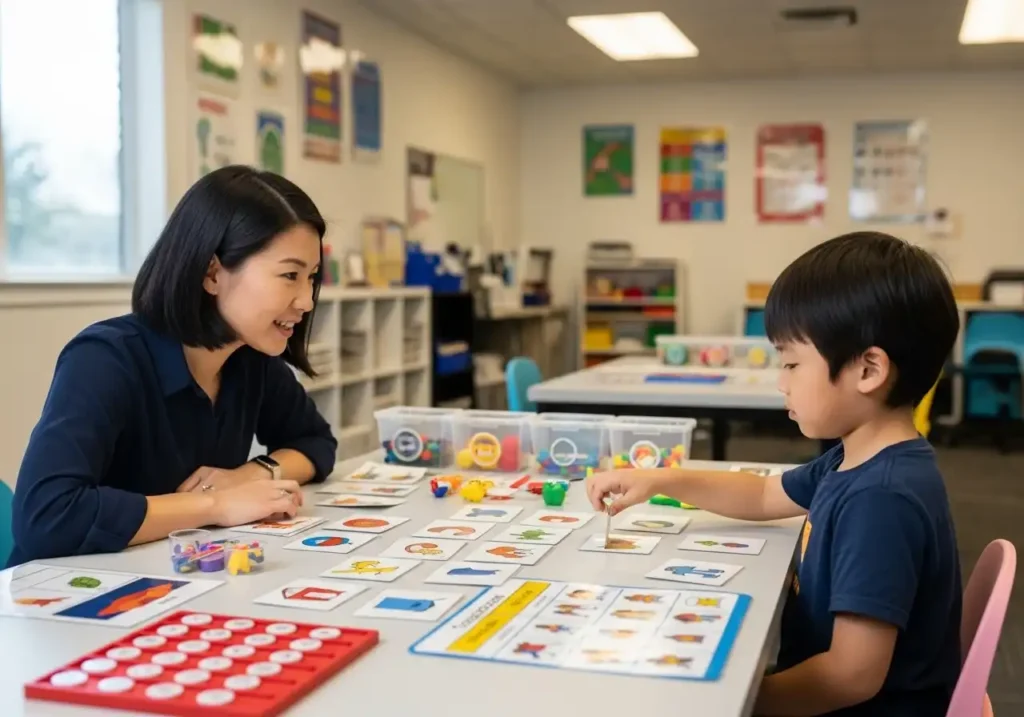
The 3 main types of therapy that support children with GDD are:
- Applied Behavior Analysis (ABA) Therapy is a well-researched approach that breaks learning into small, achievable steps and uses positive reinforcement to support skill acquisition. For children with GDD, ABA focuses on developing communication, learning-to-learn skills, daily living skills, play, and early readiness for group learning.
- Speech and Language Therapy supports children in understanding and using language to communicate effectively. This includes following instructions, expressing needs and ideas, developing vocabulary and sentences, and building early social communication skills. For children who are non-speaking or minimally speaking, speech therapists may also introduce alternative and augmentative communication (AAC) to support functional communication.
- Occupational Therapy focuses on the physical, sensory, and functional aspects of development. It support gross and fine motor skills, balance and coordination, sensory processing, and everyday skills such as feeding, dressing, and toileting, while also building the motor foundations needed for future school participation.
At Tesserae, we take a collaborative ABA approach, working closely with other therapists to support children with GDD. By building strong foundations for learning, such as attention, engagement, and readiness to learn, ABA helps enable the work of other disciplines and supports children in making steady progress and participating more meaningfully across everyday environments.
Public vs. Private Support
Choosing between public and private support for children with GDD is a common consideration for families. In Singapore, both public and private healthcare systems can provide developmental evaluations and access to intervention services, each with different strengths. Public services through polyclinics and restructured hospitals are more affordable due to government subsidies, but waiting times for specialist appointments and therapy placements can extend over several months.
Private support typically offers shorter waiting times and greater flexibility, allowing families to access assessments and begin intervention more promptly. Sessions may also be longer or more individualised, which can be helpful for younger children or those with more complex developmental needs.
When deciding between public and private options, families may wish to consider their timeline, financial considerations, and how soon support is needed. For some, public services provide a good long-term pathway. For others, private support can help bridge gaps or provide earlier intervention during a period when time and consistency matter most.
How can ABA therapy help with GDD?
Applied Behaviour Analysis (ABA) is a well-researched, systematic approach that breaks down skills into small steps and uses positive reinforcement to help children learn.
For children with GDD, ABA therapy is:
- Personalised: Every child’s programme is tailored to their unique profile, strengths, and goals.
- Focused on real-life skills: From communication and social interaction to daily routines and school readiness.
- Flexible and collaborative: Therapy is delivered 1-to-1, with close involvement of parents, other therapists (e.g. occupational therapists, speech therapists) and, when possible, schools.
- Progress-driven: Goals are tracked and adjusted regularly to ensure meaningful improvements.
Parents often find ABA especially effective because it breaks down complex skills into manageable steps, making learning clear and achievable for children who may otherwise struggle in group settings.

Want to understand how ABA can help your child with GDD?
Supporting Your Child with GDD at School and Home
Creating supportive environments both at school and at home is essential for children with GDD to thrive. Singapore’s education system offers various accommodations, while parents can implement strategies to help their children succeed.

Government Support in Singapore
Singapore offers several forms of support for children with GDD and other developmental needs.
Early Intervention Programme for Infants and Children (EIPIC)
EIPIC provides centre-based early intervention for children up to the age of six, focusing on communication, social skills, school readiness and daily living skills. It is heavily subsidised, making it an important option for many families.
Other forms of support may include:
- Preschool-based intervention programmes
- SPED school placement for children who require a more specialised environment
- Financial subsidies and grants administered through agencies such as SG Enable
- Special Educational Needs (SEN) support in mainstream preschools and primary schools
Many families choose to combine EIPIC with private therapies, such as ABA-led programmes, to increase intensity and individualisation.
Choosing the Right School Pathway
Educational decisions are often a key concern for parents of children with GDD. Broadly, the options include:
- Mainstream preschools and primary schools with SEN support
- SPED schools designed for children with more significant support needs
- Blended pathways, where a child may start with more support and move towards inclusive settings over time
The goal is to identify the least restrictive environment where your child can still make progress and cope emotionally. This may change over time as your child develops new skills.
At Tesserae, part of our role is to advise and collaborate with you on school readiness, transition planning and working with teachers and SEN teams so that therapy and schooling work hand-in-hand.
Supporting Your Child at Home
What you do at home makes a huge difference. Key principles include:
- Structure and routine – predictable schedules help children feel secure and reduce frustration.
- Simple, clear instructions – break tasks into small steps and guide your child one step at a time.
- Practice through daily life – use mealtimes, bath time, play, and walks as opportunities to practise communication, motor skills and independence.
- Positive reinforcement – notice and praise small successes quickly and specifically (“I like how you packed your toys away!”).
- Teamwork with therapists – ask for home practice ideas and share your observations so therapy goals stay relevant to real life.
You do not have to do everything perfectly. Consistency and collaboration matter far more than perfection.
If you’d like guidance on how to build these strategies into a structured programme, or want support tailored to your child’s needs, we’re here to help.
Disclaimer: This article is for informational purposes only and does not constitute medical advice. Please consult with qualified healthcare professionals for personalised diagnosis and treatment recommendations for your child.
Content
Book a free discovery call with us